Saturday, 11 May 2019

Pakistan plans to ease visa policy for 55 countries to revive tourism

Pakistan plans to ease visa policy for 55 countries to revive tourism


In an attempt to revive tourism, Pakistan is planning to ease visa restrictions for visitors from 55 countries, Reuters reported Saturday.
Fawad Chaudhry, the information minister, told Reuters that his government is reviewing the visa policies. “We are trying to bring 55 countries into a visa-free region, which includes most of the European countries.”
Earlier this month, Portugal declared Pakistan safe for travel and Fawad Chaudhry is happy about it. “I’m happy our (travel) advisories are changing,” he added.
He said that former Portuguese captain Luis Figo and Brazil’s Kaka were recently denied visas to Pakistan for a promotional visit.
The information minister told Reuters that he called the section officer and he told him that he never heard of Kaka. “I spoke to the interior secretary yesterday and gave him a piece of my mind.”
However, the football greats will be issued visas soon, the minister added.

Monday, 22 April 2019

Undersea pipeline: $10 bn Russian investment to benefit Pakistan

Undersea pipeline: $10 bn Russian investment to benefit Pakistan

ISLAMABAD: Russian company Gazprom is to lay down a $10 billion undersea gas pipeline not specifically for Pakistan but for the region that initially will be laid down from the Persian Gulf up to India touching Pakistani waters and Bangladesh’s coastal areas.


‘’So the impression that building a $10 billion undersea gas pipeline is investment for Pakistan is wrong, as it is for other regional countries as well,’’ a top official at the Petroleum Division confirmed to The News.

Pakistan and India have already signed MoUs and agreements with Russia separately for the project under which both countries would get gas from the undersea pipeline through the spur pipelines.

However, the three countries, Pakistan, India and Bangladesh, will benefit from the $10 billion Russian investment as buyer countries. Managing Director Inter-State Gas System Mobin Saulat also confirmed that the undersea pipeline would be laid down with an estimated investment of $10 for the regional countries. However, in the same breath he said, “Since the undersea pipeline will provide gas up to 1bcfd, so it is investment for Pakistan too.’’

And more importantly, Pakistan will also get transit fee in dollar terms for the undersea pipeline that is to pass through Pakistan’s sea territory. He also said Russia-Pakistan economic corridor will also be set up and Russia will also invest in fiber optic link, roads and power projects as ancillary facilities.

Saulat said Pakistan will take the gas up to 1bcf per day when the said pipeline will come on stream with massive rollover impact on economy. Russia is already engaged with Pakistan on North South Gas Pipeline, which will cost $2-2.5 billion. However, Gazprom has also shown interest in building gas storages in Pakistan with investment of $400-500 million.

Russia is also interested in investing in exploration and production activities in Pakistan and to this effect Gazprom is currently engaged with the top management of OGDCL.

However, under the agreement, another top Petroleum Division official said Gazprom Company from gas deposits in Iran and in other Middle East countries owned by Russia will ensure gas sourcing in the pipeline for the said buyer countries. The buyer countries under separate agreements with the said Russian company will have gas intakes from the said pipeline.

The official said Pakistan will share its credible data with Russian company about the demand of gas with future projections in next one decade keeping in view existing pricing structure, and regulatory and taxation regimes. The data for demand would be worked out keeping view the renewable power policy and future LNG terminal being installed by private companies.

‘’The same data India will provide to Russian company too.’’ After having the required data from Pakistan and India, the Russian company will ink commercial agreements with buyer countries. Based on data from both the countries, Gazprom will carry out the feasibility and the whole process staring from sharing the data to completion of feasibility report will be finished in one year time and if the project is found feasible, then the pipeline will be laid down undersea in 3-4 years. The official said under TAPI gas line project, Pakistan will be having 1.3bcf per day.

To a question, the official said that Pakistan had the option to build spur pipeline to connect the undersea pipeline and the spur pipeline will be connected to S-N pipeline. Russia may build spur pipeline also and connect to S-N pipeline which is also to be constructed by Russian company.
source: The News

Sunday, 21 April 2019

PIA reaches break-even in operating profit

PIA reaches break-even in operating profit

Says it has come out of losses at operational level after quite a long time

Pakistan International Airlines (PIA) has claimed that it has come out of losses at the operational level after quite a long time as its revenues slightly exceeded the operating cost in the quarter ended March 31, 2019.
“PIA has achieved breakeven at the operational level,” Adviser to PIA CEO Air Vice Marshal Noor Abbas told The Express Tribune. “It, however, may take three to four years to report a net profit.”
The state-owned airline’s revenue surged to an average of Rs8-8.5 billion a month in the January-March 2019 quarter compared to around Rs7 billion a month in the same period of last year. “The operating cost was slightly lower than the monthly revenue or was almost equal,” he said.
18 new planes, new routes planned for PIA
The adviser said a notable improvement in financial management came after the seat occupancy rate per flight increased to around 90% in the period under review compared to less than 70% in the corresponding period of previous year.
Moreover, the addition of four planes to the operational fleet after repair, which took more than a year, reduction in the number of employees, drastic reduction in the ticket reservation cost, increased load factor of cargo and increase in the number of flights on profit-making routes helped achieve these results.
“Such improvement in operations came following the change of management in November 2018 when Air Marshal Arshad Malik took charge as CEO of the airline,” he said. “PIA is doing well under the five-year business plan, which got approval of the cabinet very recently.”
He revealed that PIA had been saving roughly Rs1 billion a month since it acquired the new ticket reservation software from Turkey-based firm Hitit in October 2018. “The new reservation software is costing half of what PIA was paying to the US-based firm Saber.”
“The saving is playing a major role in turning around the airline,” he said.
Grounded planes return to air
The adviser said seven aircraft had been grounded for repair and maintenance at the time the new management took over the airline. Some of them had remained in the hangar for over a year due to lack of finances. “We have now put four of them in the operational fleet,” Abbas said.
PIA business plan to be ready by March
It became possible after the government extended sovereign guarantees for commercial loans worth Rs5.6 billion for repair and maintenance in February 2019.
“Another two grounded aircraft – Boing 777 AP-BHV and A-320 AP-BLV – will start flying by mid-May,” he said. “The required parts have arrived from original equipment manufacturers (OEMs) in the US and Europe.”
Cargo
load improves
He said the cargo load factor had also increased to over 70% these days compared to less than 50% about six months ago. “Accordingly, the share of revenue from cargo operations has increased to 7-8% in the total revenue compared to around 5% earlier,” he said.
New planes
He said the management had planned to increase the fleet to around 45 aircraft under the five-year business plan from 32 at present. “First of the new aircraft is expected to be acquired in the current calendar year.”
He, however, said it had not yet been decided whether the first aircraft would be narrow or wide-body plane. However, 60% of the 13 new aircraft would be narrow-body and the remaining would be wide-body.
HR rationalisation
He said the state-owned airline had started the process of human resources rationalisation. “We need to cut human resource by 25-30%. We may do so in the next two to three months. The rationalisation drive kicked off in January,” he said.
There are around 13,000 regular employees and another 3,000 outsourced employees of PIA.
He added the impact of HR rationalisation would not be at the mass level as 500-600 employees were leaving the organisation themselves every year including around 400 who were reaching the retirement age.
Routes rationalisation
He said PIA had increased the number of flights and started flying on around eight new international routes, mostly in the Middle East, since the change in management in November 2018. “PIA is also going to start flights on the Islamabad-Muscat route on April 23. This will be the ninth new route in less than six months.”
Besides, it has stopped and suspended flights on a couple of loss-making routes under the rationalisation programme
PIA reaches break-even in operating profit PIA reaches break-even in operating profit

Sunday, 28 January 2018

گلگت بلتستان

بابوسر ٹاپ۔۔۔۔ چلاس۔۔  دیوسائی گلگت بلتستان ۔۔۔۔۔۔۔۔

 دنیا کا سب سے اونچا پہاڑی میدانی سلسلہ  جہاں جون جولائی میں بھی زیادہ موسم خراب رھے تو برفباری کا امکان ھے۔۔۔۔ 
اور سال کے سات تا اٹھ مہینے یہاں برف رھتی ھے ۔ پچھلی برف نہیں پگھل پاتی اسی دوران اگلی برفباری کا سیزن اجاتا ھے ۔😊
یہ سطح سمندر سے1734 میٹر یعنی 13691 فٹ بلند ھے ۔۔۔۔۔ 
یہ چلاس کو شاھراہ قراقرم سے ملاتا ھے

Friday, 12 January 2018

Reconstruction of the Karakoram Highway


Reconstruction of the Karakoram Highway


As part of the China–Pakistan Economic Corridor, reconstruction and upgrade works are underway on the 887-kilometre-long (551 mi) National Highway 35 (N-35), which forms the Pakistani portion of the Karakoram Highway.


Route description


The KKH spans the 887-kilometre-long (551 mi) distance between the China–Pakistan border and the town of Hasan Abdal. At Burhan Interchange near Hasan Abdal, the existing M1 motorway will intersect the N-35 at the Shah Maqsood Interchange. From there, access onwards to Islamabad and Lahore continues as part of the existing M1 and M2 motorways. Hasan Abdal will also be at intersection of the Eastern Alignment, and Western Alignment.
E-35 Expressway between Hasan Abdal and Havelian


Upgrades to the 487-kilometre-long (303 mi) section between Hasan Abdal and Raikot of the Karakoram Highway are officially referred to in Pakistan as the Karakoram Highway Phase 2 project. At the southern end of the N-35, works are already underway to construct a 59-kilometre-long (37 mi), six-lane controlled-access highway between Hasan Abdal and Havelian which upon completion will be officially referred to as the E-35 expressway, or Hazara Motorway.
Havelian to Shinkiari


North of Havelian, the next 66 kilometres (41 mi) of road will be upgraded to a four-lane dual carriageway between Havelian and Shinkiari. Groundbreaking on this portion commenced in April 2016.
Shinkiari to Thakot


The entire 354 kilometres (220 mi) of roadway north of Shinkiari and ending in Raikot, near Chilas will be constructed as a two-lane highway. Construction on the first section between Shinkiari and Thakot commenced in April 2016 jointly with construction of the Havelian to Shinkiari four-lane dual carriageway further south. Construction on both these sections is expected to be completed with 42 months at a cost of approximately $1.26 billion with 90% of funding to come from China's EXIM bank in the form of low interest rate concessional loans.
Thakot to Raikot


Between Thakot and Raikot spans an area in which the government of Pakistan is currently either planning or actively constructing several hydropower projects, most notably the Diamer-Bhasha Damand Dasu Dam. Sections of the N-35 around these projects will be completely rebuilt in tandem with dam construction In the interim, this section of the N-35 is currently being upgraded from its current state until dam construction commences in full force at a later date. Improvement projects on this section are expected to be completed by January 2017 at a cost of approximately $72 million.


In Dec 2017, China suspended funding for portion of Karakorum Highway (KKH) from Raikot to Thakot on allegations of corruptions in the project.
Raikot to the Chinese border


The next 335 kilometres (208 mi) of roadway connect Raikot to the China-Pakistan border. Reconstruction works on this section of roadway preceded the CPEC, and were initiated after severe damage to roadways in the area following the 2010 Pakistan floods. Most of this section of roadway was completed in September 2012 at a cost of $510 million, and was severely dilapidated even prior to the 2010 flooding.
China-Pakistan Friendship Tunnels


In addition to flooding, a large earthquake rocked the region nearest to the China-Pakistan border in 2010, triggering massive landslides which dammed the Hunza River, and resulted in the formation of the Attabad Lake. Portions of the N-35 were submerged in the lake, forcing all vehicular traffic onto barges to traverse the new reservoir. Construction on a 24-kilometre (15 mi) series of bridges and tunnels to Attabad Lake began in 2012 and required 36 months for completion. The bypass consists of two large bridges, 78 culverts and five kilometres (3.1 mi) worth of tunnels that were inaugurated for public use on 14 September 2015 at a cost of $275 million.
Gilgit to Skardu


The 175-kilometre (109 mi) road between Gilgit and Skardu will be upgraded to a four-lane road at a cost of $475 million to provide direct access to Skardu from the N-35.
Cost and Financing


As part of CPEC, approximately $11 billion worth of infrastructure projects being developed by the Pakistani government will be financed by concessionary loans, with composite interest rates of 1.6%, after Pakistan successfully lobbied the Chinese government to reduce interest rates from an initial 3%. The concessional loans are subsidised by the government of China, and are to be dispersed by the Exim Bank of China and the China Development Bank. For comparison, loans for previous Pakistani infrastructure projects financed by the World Bank carried an interest rate between 5% and 8.5%, while interest rates on market loans approach 12%.


The China Development Bank will finance the $920 million towards the cost of reconstruction of the 487-kilometre (303 mi) portion of the Karakoram Highway between Hasan Abdal and Raikot.


An addition $1.26 billion will be lent by the China Exim Bank for the construction of the Havelian to Thakot portion of this stretch of roadway, to be dispersed as low-interest rate concessional loans.


Construction works on the China-Pakistan Friendship Tunnels can be traced to 2013, when China began construction on a 24-kilometre (15 mi) bypass of Attabad Lake with a combination of 5 km worth of tunnels, two large bridges, and 78 small bridges to bypass the lake which had been formed after a 2010 earthquake triggered massive landslides. The resulting landslides cut off both the Indus River and Karakoram Highway resulting in the formation of the reservoir. Prior to completion of the bypass, all vehicular traffic had to be loaded onto barges to traverse the new reservoir. Construction of the tunnels began in 2012 and required 36 months for completion. The 24 km long series of bridges and tunnels was inaugurated on 15 September 2015 at a cost of $275 million and was hailed as a major accomplishment.

Tuesday, 9 January 2018

Travel Guide to Pakistan

Travel Guide to Pakistan

Welcome to the fabulous Pakistan!
Pakistan is situated in the west of India and china while Iran and Afghanistan share their border with Pakistan on western side. Pakistan although a very peaceful and very friendly nation has been very badly hit by the notorious war on terrorism by the countries who always envied the landscape and blessing of the country. The local media the war on terror leaders have now destroyed peace and tranquility of some areas of Pakistan's in a game that no one understands. This game is not an old one similar games (Gilgit Game, Great game) were played on this soil many years ago by similar powers.

Saturday, 30 December 2017

محسن نقوی


قریہ جاں میں اُبھرنے لگا  
پھر گریہ شب پھر ملا
 اِذن تکلم پئے 

Thursday, 21 December 2017

آرمی چیف کو ملکی تاریخ میں پہلی بار سینیٹ بلایا گیا۔ سینٹ کو کئی معاملات پر تشویش تھی جنکا تسلی بخش جواب دیا گیا۔ چند ایک پیش خدمت ہیں۔

آرمی چیف کو ملکی تاریخ میں پہلی بار سینیٹ بلایا گیا۔ سینٹ کو کئی معاملات پر تشویش تھی جنکا تسلی بخش جواب دیا گیا۔ چند ایک پیش خدمت ہیں۔
اندرونی سیکیورٹی کے لیے کیا گیا اب تک ؟

Saturday, 2 December 2017

ہفتہ وحدت تمام مسلمین وہ مومینین کو مبارک پیغام ہفتہ وحدت


Lahore


Lahore (/ləˈhɔːr/) (Punjabi: لہور‎; Urdu: لاہور‎‎) is the capital city of the Pakistani province of Punjab. It is the second-most populous cityin Pakistan after Karachi. The city is located in the north-eastern end of Pakistan's Punjab province, near the border with the Indianstate of Punjab. Lahore is ranked as a beta-world city, and is one of Pakistan's wealthiest cities with an estimated GDP of $58.14 billion (PPP) as of 2014.


Lahore is the historic cultural centre of the Punjab region, and is the largest Punjabi city in the world.[14] The city has a long history, and was once under the rule of the Hindu Shahis, Ghaznavids, Ghurids, and the Delhi Sultanate. Lahore reached the height of its splendour under the Mughal Empire, serving as its capital city for a number of years. The city was captured by the forces of Persian Afsharid Emperor Nader Shah during his invasion of the Mughal Empire. The city was then contested between different powers before it became capital of the Sikh Empire, and then the capital of the Punjab under British rule. Lahore was central to the independence movements of both India and Pakistan, with the city being the site of both the declaration of Indian Independence, and the resolution calling for the establishment of Pakistan. Following the independence of Pakistan in 1947, Lahore became the capital of Pakistan's Punjab province.


Lahore is one of Pakistan's most liberal and cosmopolitan cities. It exerts a strong cultural influence over Pakistan. Lahore is a major centre for Pakistan's publishing industry, and remains the foremost centre of Pakistan's literary scene. The city is also a major centre of education in Pakistan, with some of Pakistan's leading universities based in the city. Lahore is also home to Pakistan's film industry, Lollywood, and is a major centre of Qawwali music. The city also hosts much of Pakistan's tourist industry, with major attractions including the old Walled City, numerous Sikh shrines, and the Badshahi and Wazir Khanmosques. Lahore is also home to the UNESCO World Heritage Sites of Lahore Fort and Shalimar Gardens.

Karachi (Urdu: کراچی‎‎: Karācī, Sindhi: ڪراچي‎)


Karachi (Urdu: کراچی‎: Karācī, Sindhi: ڪراچي‎) is the capital of the Pakistani province of Sindh. It is the most populous city in Pakistan, sixth most populous city proper in the world and the 8th most populous metropolitan city in the world. Ranked as a beta world city, the city is Pakistan's premier industrial and financial center. Karachi is also Pakistan's most cosmopolitan city. Situated on the Arabian Sea, Karachi serves as a transport hub, and is home to two of Pakistan's two largest seaports, the Port of Karachi and Port Bin Qasim, as well as the busiest airport in Pakistan.
Though the Karachi region has been inhabited for millennia, the city was founded as the fortified village of Kolachi in 1729. The settlement drastically increased in importance with the arrival of British East India company in the mid 19th century, who not only embarked on major works to transform the city into a major seaport, but also connected it with their extensive railway network. By the time of the Partition of British India, the city was the largest in Sindh with an estimated population of 400,000. Following the independence of Pakistan, the city's population increased dramatically with the arrival of hundreds of thousands of Muslim refugees from India. The city experienced rapid economic growth following independence, attracting migrants from throughout Pakistan and South Asia.
Karachi is one of Pakistan's most secular and socially liberal cities. It is also the most linguistically, ethnically, and religiously diverse city in Pakistan. With a population of 14.9 million recorded in the 2017 Census of Pakistan, Karachi is considered to be the second largest city after Jakarta within the Muslim majority countries, and is the world's 10th most populous urban agglomeration. Karachi is one of the world's fastest growing cities, and has communities representing almost every ethnic group in Pakistan. Karachi is home to over 2 million Bangladeshi immigrants, 1 million Afghan refugees, and up to 400,000 Rohingyas from Myanmar. Karachi is now Pakistan's premier industrial and financial center. The city has a formal economy estimated to be worth $113 billion as of 2014. Karachi collects over a third of Pakistan's tax revenue, and generates approximately 20% of Pakistan's GDP. Approximately 30% of Pakistani industrial output is from Karachi, while Karachi's ports handle approximately 95% of Pakistan's foreign trade. Approximately 90% of the multinational corporations operating in Pakistan are headquartered in Karachi. Up to 70% of Karachi's workforce is employed in the informal economy, which is typically not included in GDP calculations.
Known as the "City of Lights" in the 1960s and 1970s for its vibrant nightlife, Karachi was beset by sharp ethnic, sectarian, and political conflict in the 1980s with the arrival of weaponry during the Soviet–Afghan War. The city had become well known for its high rates of violent crime, but recorded crimes sharply decreased following a controversial crackdown operation against criminals, the MQM political party, and Islamist militants initiated in 2013 by the Pakistan Rangers. The city's murder rate in 2015 had decreased by 75% compared to 2013, and kidnappings decreased by 90%, with the improved security environment triggering sharp increases in real-estate prices

Islamabad اسلام آباد‎‎


Islamabad  اسلام آباد‎, Islāmābād, is the capital city of Pakistan located within the federal Islamabad Capital Territory. With a population of 1.01 million, it is the 9th largest city of Pakistan, while the larger Islamabad-Rawalpindi metropolitan area is the third largest in Pakistan with a population exceeding four million. The city is the political seat of Pakistan and is administered by the Islamabad Metropolitan Corporation, supported by the Capital Development Authority (CDA).
Islamabad is located in the Pothohar Plateau in the northeastern part of the country, between Rawalpindi District and the Margalla Hills National Park to the north. The region has historically been a part of the crossroads of Punjab and Khyber Pakhtunkhwa with the Margalla Pass acting as the gateway between the two regions.
Islamabad was built during the 1960s to replace Karachi as Pakistan's capital. The city's master-plan divides the city into eight zones, including administrative, diplomatic enclave, residential areas, educational sectors, industrial sectors, commercial areas, and rural and green areas. The city is known for the presence of several parks and forests, including the Margalla Hills National Park and Shakarparian Park.The city is home to several landmarks, including the Faisal Mosque, the largest mosque in South Asia and the fourth largest in the world. Other landmarks include the Pakistan's National Monument and Democracy Square.
Islamabad is a beta- world city; it is categorised as very high on the Human Development Index, the highest in the country. The city has the highest cost of living in Pakistan, and its population is dominated by middle and upper middle class citizens.The city is home to sixteen universities, including the Quaid-e-Azam University, COMSATS Institute of Information Technology and NUST. The city is one of the safest in Pakistan, and has an expansive surveillance system with 1,900 CCTV cameras.

The Islamic Republic of Pakistan (Urdu: اسلامی جمہوریہ پاکستان‎‎)

Pakistani Flag


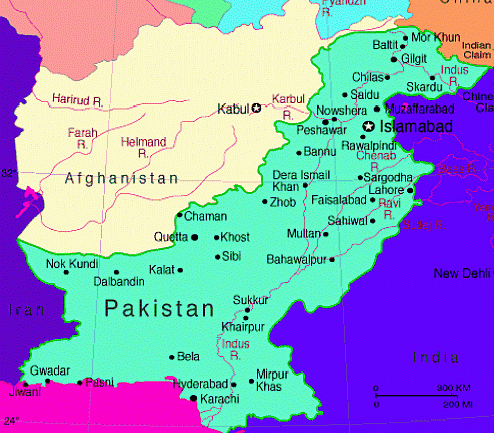
Pakistan (/ˈpækɪstæn) or /pɑːkɪˈstɑːn/); Urdu: پاکستان‎‎), officially the Islamic Republic of Pakistan (Urdu: اسلامی جمہوریہ پاکستان‎‎), is a country in South Asia and on junction of West Asia, Central Asia and East Asia. It is the fifth-most populous country with a population exceeding 207.77 million people. In terms of area, it is the 33rd-largest country spanning 881,913 square kilometres (340,509 square miles). Pakistan has a 1,046-kilometre (650-mile) coastline along the Arabian Sea and its Gulf of Oman in the south and is bordered by India to the east, Afghanistan to the west, Iran to the southwest, and China in the far northeast, respectively. It is separated narrowly from Tajikistan by Afghanistan's Wakhan Corridor in the north-west, and also shares a maritime border with Oman.

The territory that now constitutes Pakistan was the site of several ancient cultures, including the Mehrgarh of the Neolithic and the Bronze Age Indus Valley Civilisation, and was later home to kingdoms ruled by people of different faiths and cultures, including Hindus, Indo-Greeks, Muslims, Turco-Mongols, Afghans, and Sikhs. The area has been ruled by numerous empires and dynasties, including the Persian Achaemenid Empire, Alexander III of Macedon, the Indian Mauryan Empire, the Arab Umayyad Caliphate, the Delhi Sultanate, the Mongol Empire, the Mughal Empire, the Afghan Durrani Empire, the Sikh Empire (partially), and most recently, the British Empire.

Pakistan is unique among Muslim countries in that it is the only country to have been created in the name of Islam. As a result of the Pakistan Movement led by Muhammad Ali Jinnah and the subcontinent's struggle for independence, Pakistan was created in 1947 as an independent homeland for Indian Muslims. It is an ethnically and linguistically diverse country, with a similarly diverse geography and wildlife. Initially a dominion, Pakistan adopted a constitution in 1956, becoming an Islamic republic. An ethnic civil war in 1971 resulted in the secession of East Pakistan as the new country of Bangladesh. In 1973 Pakistan adopted a new constitution establishing, alongside its pre-existing parliamentary republic status, a federal government based in Islamabad consisting of four provinces and four federal territories. The new constitution also stipulated that all laws were to conform to the injunctions of Islam as laid down in the Quran and Sunnah.

A regional and middle power, Pakistan has the sixth-largest standing armed forces in the world and is also a nuclear power as well as a declared nuclear-weapons state, being the second in South Asia and the only nation in the Muslim world to have that status. Pakistan has a semi-industrialised economy with a well-integrated agriculture sector, and a growing services sector. The Pakistani economy is the 24th-largest in the world in terms of purchasing power and the 41st-largest in terms of nominal GDP (World Bank). It is ranked among the emerging and growth-leading economies of the world, and is backed by one of the world's largest and fastest-growing middle classes.

The post-independence history of Pakistan has been characterised by periods of military rule, political instability and conflicts with neighbouring India. The country continues to face challenging problems, including overpopulation, terrorism, poverty, illiteracy, and corruption. Pakistan is a member of the United Nations, the Non-Aligned Movement, the Organisation of Islamic Cooperation, the Commonwealth of Nations, the Economic Cooperation Organisation, the Shanghai Cooperation Organisation, the South Asian Association for Regional Cooperation, the Developing Eight, and the G20 developing nations, Group of 24, Group of 77, and ECOSOC. It is also an associate member of CERN. Pakistan is a signatory to the Kyoto Protocol, the Paris Agreement, and the International Covenant on Civil and Political Rights.

Thursday, 30 November 2017

Mery masehiah

☆میرے مسیحا☆                          
میرے مسیحا سے جاکے کہ دو
کہ دم بہ لب ہے قرارِ ہستی
کہ جاں‌گسل انتظار تیرا
کہو کہ مہمان رہ گیا ہے
بس ایک پل کا بیمار تیرا

میرے مسیحا
تیرے سفر میں ہوئی جو روشن
وہ صبحیں راتوں‌ میں‌ ڈھل گئیں‌ ہیں‌
کہ تیرے خوابوں‌کی حدتوں‌ سے
کسی کی آنکھیں‌ ہی جل گئی ہیں‌
میرے مسیحا سے جاکے کہ دو
کہ درد اتنا سوا ہوا ہے
یہ نبض جیسے تھمی ہوئی ہے
یہ وقت جیسے رکا ہوا ہے

میرے مسیحا
سہارے جس کے کٹی ہے ہر شب
وہ آس سینے میں‌ گھٹ رہی ہے
میرے مسیحا ! خبر بھی لو اب!
متاعِ جاں ہے کہ لٹ رہی ہے!
مرے مسیحا !!

Tuesday, 28 November 2017

Mohsin naqvi the legend

دل کی لغزش ہے نہ خطا ہے کوئی
بس یونہی روٹھہ گیا ہے کوئی

میں نے رک رک کے تجھے یاد کیا
دل میں جب درد اٹھا ہے کوئی

یا ہوا خاک اڑاتی ہو گی
یا مجھے ڈھونڈ رہا ہے کوئی

موت آتی ہے نہ تو آتا ہے
یہ بھی جینے کی سزا ہے کوئی

اب وہ ملتا ہے تو یوں لگتا ہے
سلسلہ ٹوٹ گیا ہے کوئی

سرخ ہے شہر کی شب کا چہرہ
پھر کہیں قتل ہوا ہے کوئی

اے بچھڑ کر نہ پلٹنے والے
تیرے رستے میں کھڑا ہے کوئی

شل ہوۓ ہاتھہ تو سوچا ہم نے
لوگ کہتے تھے خدا ہے کوئی

رقص کرتے ہیں صبا کے جھونکے
شاخ پر پھول کھلا ہے کوئی

اے صبا یاد دلانا اس کو
اب اسے بھول چکا ہے کوئی

پھر میرے پھول کتابیں میری
راہ میں چھوڑ گیا ہے کوئی

ایک آوارہ پرندہ محسن
وسعت عرض و سما ہے کوئی

محسن نقوی

islamabad


Islamabad the capital city of Pakistan, has been ranked second in the list of world’s most beautiful capitals followed by Paris, Washington, Berlin and Tokyo. London remained at the top of the list that included ten most beautiful capitals of the world. Russian capital, Moscow, remained at the bottom of the list.
The complete list issued by Top Ten Findings:
List

Friday, 24 November 2017

20 Facts about Pakistan to be Proud of


1. In the last five years, Pakistan’s literacy rate has grown by 250%, the largest increase in any country to date.

2. Pakistan is the first Islamic country to attain nuclear power.

3. Edhi is running the World’s largest Ambulance network.

4. World’s youngest certified Microsoft Experts Arfa Kareem (Late) and Babar Iqbal are from Pakistan.

5. Pakistan has the sixth largest military force in the world.

6. Pakistan’s national anthem tune ranks first in the top three tunes of the world.

7. Fourth largest broadband internet system of world is in Pakistan

8. World’s largest deep sea port is Gwadar.

9. About 50% of the world’s footballs are made in Pakistan.

10. Pakistan is notable for having one of the best trained air-force pilots in the world.

11. Pakistan has world’s youngest civil judge, Muhammad Illyas.

12. The highest railway station of Asia is in Pakistan.

13. First PC virus was created by two Pakistani brothers. (Maybe not something to be very proud of, but it still might have required an impressive level of intellect to do so).

14. Dr. Abdus Salam – Nobel prize winner (Physics 1979).

15. LUMS (Lahore University of Management Sciences) attracts students from Middle East, the Far East, Central Asia, and other parts of South Asia.

16. Ustaad Nusrat Fateh Ali Khan, hailed as the most important Qawwali singer of the 20th century and received many awards around the globe such as The “Legends” award at the UK Asian Music Awards (2005).

17. World’s 7th largest Pool of Scientists and Engineer.

18. The Shah Faisal Mosque in Islamabad can accommodate almost 100,000 worshipers. Completed in 1976, it could at that time probably hold the city’s entire population.

19. Karakoram Highway runs through the northern areas connecting Pakistan with China’s Xingjiang province is often described as ” Eighth Wonder of the World” due to the marvel of civil engineering as it has taken 15 years to complete by the Pakistan Army Engineers in collaboration with China. It’s been labeled as ” World’s highest paved international Road” under world’s toughest terrain.

20. Air Commodore MM ALAM (Late) has a world record of shooting down 5 planes in less than a Minute.

Despite all the mishaps, destruction and loss, we’ve shown alot of progress. We still have time to improve more since hoaxes such as Y2K and 21st December 2012 actually did turn out to be a false alarm. One of the most amazing facts which people are seeing is that a majority is protesting the violence. We want to change. And since we’re still living let’s bring out the best of us and our country.

Sunday, 4 June 2017

تم کو سب کچھ یاد ہی ہو گا

تم کو سب کچھ یاد ہی ہو گا
-
یاد ہے اکثر تم کہتی تھیں
جب میں اپنی سانسوں کی
اور دھڑکن کی ترتیب لگاؤں
کتنا سادہ کتنا پیارا
نام تمہارا بن جاتا ہے
میں گھنٹوں سنتی رہتی ہوں
یاد ہے جب تم
میرے سینے پر سر رکھ کے 
میری سانس سنا کرتیں
یا اپنا نام سنا کرتی تھیں
یاد ہے اک دن
’’سانوں اک پل چین نہ آوے‘‘
میری فرمائش پر تم نے
نصرت کا یہ گیت سنا تھا
اور گھنٹوں محسوس کیا تھا
(شاید مجھ کو)
یاد ہے تم کو جب تم کالے رنگ کے 
کپڑے پہنا کرتیں، تو یہ کہتیں
دیکھو میں کچھ خاص نہیں ہوں
جانے کیوں تیری آنکھوں کو
میں اتنی سندر لگتی ہوں!
یہ تو تم کو یاد ہی ہو گا
جب تم مجھ سے یہ کہتیں تھیں
آپ کے جیسا کوئی نہیں ہے
آپ بہت ہی اچھے ہیں نا
ایسے منہ مت پھیرا کیجئے!
دیکھیں میں دل سے کہتی ہوں
مجھ سے چاہے اپنے سر کی
ایک نہیں، دو چار نہیں تو
جتنی چاہے قسمیں لیجے
میں یہ بالکل سچ کہتی ہوں
اب دوری نہ سہہ پاؤں گی
آپ سے دور نہ رہ پاؤں گی
مجھ کو چھوڑ کے مت جائیے گا
میری خاطر رُک جائیے گا
مجھ کو چاہے جیسے رکھیئے
آپ کے ساتھ ہی رہنا ہے بس
اور کسی کا سایا بھی نہ
اپنے کے پاس کبھی لاؤں گی
آپ سے دور نہ رہ پاؤں گی
یاد ہے مجھ سے جب کہتی تھیں
آپ بھی کتنے سادہ ہیں نا
اپنی عمر کے لڑکے دیکھیں
تھوڑا سا تو فیشن کیجئے
بالوں کا وہ ’کٹ‘ بنوائیں
کالر والی پرپل شرٹ میں
آپ کمال لگیں گے سچ میں
کتنی ساری باتیں تھیں ناں
تم کو تو سب یاد ہی ہوگا
پھر بھی مجھ کو یوں لگتا ہے
مجھ کو ٹھیک سے یاد نہیں ہے!
اک مدت جو بیت گئی ہے
میرے ہاں تو یہ عالم ہے
پہروں سوچوں
گھنٹوں تم کو یاد کروں تو
تب جا کر ہی
دھندلا دھندلا سا اک چہرہ
یاد آتا ہے ہلکا ہلکا
وہ بھی اتنی مشکل سے کہ
بیچ میں اتنے زخمی لمحے 
درد جگانے آجاتے ہیں
ڈر جاتا ہوں
اور وہ دھندلا عکس بھی مجھ سے
کھو جاتا ہے!
جب سے قسمیں، وعدے سارے
بھول گئی ہو، تب سے جاناں
یوں لگتا ہے
سارے ہوش ہوئے لاوارث
ہر احساس کاخون ہوا ہے
میری سانسیں جن میں اکثر
اپنا نام سنا کرتیں تھیں
بے ترتیبی کے عالم میں
ساری سانسیں بکھر گئی ہیں
نصرت کا وہ گیت تو اب بھی
چین نہیں آنے دیتا ہے
کالے کپڑے جب دیکھوں تو
یوں لگتا ہے 
جیسے اک بے نام محبت
یا شاید گمنام محبت 
ہجر کا ماتم کرتے کرتے
گہرے سوگ میں ڈوب گئی ہے
میرے سر کی قسمیں ٹوٹیں
اور کسی کے سائے سے ڈرتے
میرا سایہ بھول گئی ہو
مجھ کو ایسے تیز ہوا میں
جلتے بجھتے اک بے چارے
دیپ کی مانند چھوڑ گئی ہو
دیکھو میں کتنا اچھا تھا
میرے جیسا کوئی نہیں تھا
تم کہتیں تھیں!
یاد ہی ہو گا!
پھر بھی رشتہ توڑ گئی ہو!
دیکھو عرصہ بیت گیا ہے
سارے فیشن بدل گئے ہیں
اب یہ بھی معلوم نہیں ہے
میں اب کیسے بال بناؤں؟
کیسے کیسے کپڑے پہنوں؟
بال بھی اب تو بکھر گئے ہیں
سارے کپڑے اُدھڑ گئے ہیں
تم کو تو سب بیتی باتیں
یاد ہی ہوں گی
مجھ کو ٹھیک سے یاد نہیں ہیں
مجھ کو تو اب ہجر زدہ دیوانوں جیسی
ٹھنڈی ٹھنڈی ،پُر اسرار سی
آہیں بھرنا آتی ہیں بس
کچھ لکھوں تو 
درد قلم سے باہر آ کر
خود کاغذ پر گر جاتا ہے
تیری باتیں بھول گیا ہوں
غم مجھ سے باتیں کرتے ہیں
اب کوئی بھی قسم اُٹھائے
یوں لگتا ہے یہ جھوٹا ہے
جانے کیسے حال میں ہوں میں
خود بھی تو معلوم نہیں ہے
لیکن یہ سب تم کو جا کر کون بتائے
ہو سکتا ہے تم بھی سب کچھ بھول چکیں ہوں
یہ تو اک مفروضہ ہے نا
’’کہ سب تم کو یاد ہی ہوگا‘‘
لیکن جاناں میری جانب
بے خبری کا یہ عالم ہے
یادیں ساتھ نہیں دیتیں اب
باتیں یاد نہیں رہتیں!!!۔۔!

Wednesday, 29 March 2017

Pakistan

Pakistan, officially the Islamic Republic of Pakistan, is a federal parliamentary republic in South Asia on crossroads of Central Asia and Western Asia. It is the sixth-most populous country with a population exceeding 200 million people.
Capital: Islamabad
Dialing code: +92
National anthem: National Anthem Of Pakistan
Population: 182.1 million (2013) World Bank
Prime minister: Nawaz Sharif
President: Mamnoon Hussain
Currency: Pakistani rupee

Pakistan plans to ease visa policy for 55 countries to revive tourism

Pakistan plans to ease visa policy for 55 countries to revive tourism In an attempt to revive tourism, Pakistan is planning to ease...