Tuesday, 9 January 2018

Travel Guide to Pakistan

Travel Guide to Pakistan

Welcome to the fabulous Pakistan!
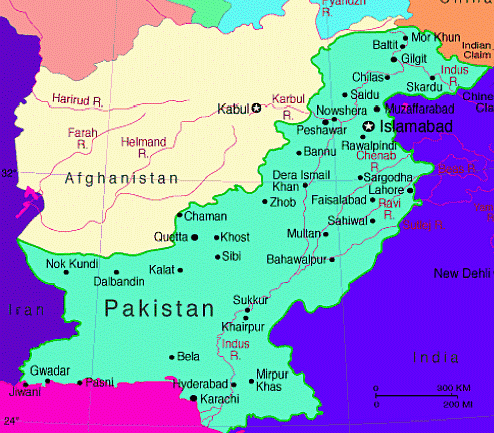
Pakistan is situated in the west of India and china while Iran and Afghanistan share their border with Pakistan on western side. Pakistan although a very peaceful and very friendly nation has been very badly hit by the notorious war on terrorism by the countries who always envied the landscape and blessing of the country. The local media the war on terror leaders have now destroyed peace and tranquility of some areas of Pakistan's in a game that no one understands. This game is not an old one similar games (Gilgit Game, Great game) were played on this soil many years ago by similar powers.

Saturday, 30 December 2017

محسن نقوی


قریہ جاں میں اُبھرنے لگا  
پھر گریہ شب پھر ملا
 اِذن تکلم پئے 

Thursday, 21 December 2017

آرمی چیف کو ملکی تاریخ میں پہلی بار سینیٹ بلایا گیا۔ سینٹ کو کئی معاملات پر تشویش تھی جنکا تسلی بخش جواب دیا گیا۔ چند ایک پیش خدمت ہیں۔

آرمی چیف کو ملکی تاریخ میں پہلی بار سینیٹ بلایا گیا۔ سینٹ کو کئی معاملات پر تشویش تھی جنکا تسلی بخش جواب دیا گیا۔ چند ایک پیش خدمت ہیں۔
اندرونی سیکیورٹی کے لیے کیا گیا اب تک ؟

Saturday, 2 December 2017

ہفتہ وحدت تمام مسلمین وہ مومینین کو مبارک پیغام ہفتہ وحدت


Lahore


Lahore (/ləˈhɔːr/) (Punjabi: لہور‎; Urdu: لاہور‎‎) is the capital city of the Pakistani province of Punjab. It is the second-most populous cityin Pakistan after Karachi. The city is located in the north-eastern end of Pakistan's Punjab province, near the border with the Indianstate of Punjab. Lahore is ranked as a beta-world city, and is one of Pakistan's wealthiest cities with an estimated GDP of $58.14 billion (PPP) as of 2014.


Lahore is the historic cultural centre of the Punjab region, and is the largest Punjabi city in the world.[14] The city has a long history, and was once under the rule of the Hindu Shahis, Ghaznavids, Ghurids, and the Delhi Sultanate. Lahore reached the height of its splendour under the Mughal Empire, serving as its capital city for a number of years. The city was captured by the forces of Persian Afsharid Emperor Nader Shah during his invasion of the Mughal Empire. The city was then contested between different powers before it became capital of the Sikh Empire, and then the capital of the Punjab under British rule. Lahore was central to the independence movements of both India and Pakistan, with the city being the site of both the declaration of Indian Independence, and the resolution calling for the establishment of Pakistan. Following the independence of Pakistan in 1947, Lahore became the capital of Pakistan's Punjab province.


Lahore is one of Pakistan's most liberal and cosmopolitan cities. It exerts a strong cultural influence over Pakistan. Lahore is a major centre for Pakistan's publishing industry, and remains the foremost centre of Pakistan's literary scene. The city is also a major centre of education in Pakistan, with some of Pakistan's leading universities based in the city. Lahore is also home to Pakistan's film industry, Lollywood, and is a major centre of Qawwali music. The city also hosts much of Pakistan's tourist industry, with major attractions including the old Walled City, numerous Sikh shrines, and the Badshahi and Wazir Khanmosques. Lahore is also home to the UNESCO World Heritage Sites of Lahore Fort and Shalimar Gardens.

Karachi (Urdu: کراچی‎‎: Karācī, Sindhi: ڪراچي‎)


Karachi (Urdu: کراچی‎: Karācī, Sindhi: ڪراچي‎) is the capital of the Pakistani province of Sindh. It is the most populous city in Pakistan, sixth most populous city proper in the world and the 8th most populous metropolitan city in the world. Ranked as a beta world city, the city is Pakistan's premier industrial and financial center. Karachi is also Pakistan's most cosmopolitan city. Situated on the Arabian Sea, Karachi serves as a transport hub, and is home to two of Pakistan's two largest seaports, the Port of Karachi and Port Bin Qasim, as well as the busiest airport in Pakistan.
Though the Karachi region has been inhabited for millennia, the city was founded as the fortified village of Kolachi in 1729. The settlement drastically increased in importance with the arrival of British East India company in the mid 19th century, who not only embarked on major works to transform the city into a major seaport, but also connected it with their extensive railway network. By the time of the Partition of British India, the city was the largest in Sindh with an estimated population of 400,000. Following the independence of Pakistan, the city's population increased dramatically with the arrival of hundreds of thousands of Muslim refugees from India. The city experienced rapid economic growth following independence, attracting migrants from throughout Pakistan and South Asia.
Karachi is one of Pakistan's most secular and socially liberal cities. It is also the most linguistically, ethnically, and religiously diverse city in Pakistan. With a population of 14.9 million recorded in the 2017 Census of Pakistan, Karachi is considered to be the second largest city after Jakarta within the Muslim majority countries, and is the world's 10th most populous urban agglomeration. Karachi is one of the world's fastest growing cities, and has communities representing almost every ethnic group in Pakistan. Karachi is home to over 2 million Bangladeshi immigrants, 1 million Afghan refugees, and up to 400,000 Rohingyas from Myanmar. Karachi is now Pakistan's premier industrial and financial center. The city has a formal economy estimated to be worth $113 billion as of 2014. Karachi collects over a third of Pakistan's tax revenue, and generates approximately 20% of Pakistan's GDP. Approximately 30% of Pakistani industrial output is from Karachi, while Karachi's ports handle approximately 95% of Pakistan's foreign trade. Approximately 90% of the multinational corporations operating in Pakistan are headquartered in Karachi. Up to 70% of Karachi's workforce is employed in the informal economy, which is typically not included in GDP calculations.
Known as the "City of Lights" in the 1960s and 1970s for its vibrant nightlife, Karachi was beset by sharp ethnic, sectarian, and political conflict in the 1980s with the arrival of weaponry during the Soviet–Afghan War. The city had become well known for its high rates of violent crime, but recorded crimes sharply decreased following a controversial crackdown operation against criminals, the MQM political party, and Islamist militants initiated in 2013 by the Pakistan Rangers. The city's murder rate in 2015 had decreased by 75% compared to 2013, and kidnappings decreased by 90%, with the improved security environment triggering sharp increases in real-estate prices
Islamabad اسلام آباد‎‎


Islamabad  اسلام آباد‎, Islāmābād, is the capital city of Pakistan located within the federal Islamabad Capital Territory. With a population of 1.01 million, it is the 9th largest city of Pakistan, while the larger Islamabad-Rawalpindi metropolitan area is the third largest in Pakistan with a population exceeding four million. The city is the political seat of Pakistan and is administered by the Islamabad Metropolitan Corporation, supported by the Capital Development Authority (CDA).
Islamabad is located in the Pothohar Plateau in the northeastern part of the country, between Rawalpindi District and the Margalla Hills National Park to the north. The region has historically been a part of the crossroads of Punjab and Khyber Pakhtunkhwa with the Margalla Pass acting as the gateway between the two regions.
Islamabad was built during the 1960s to replace Karachi as Pakistan's capital. The city's master-plan divides the city into eight zones, including administrative, diplomatic enclave, residential areas, educational sectors, industrial sectors, commercial areas, and rural and green areas. The city is known for the presence of several parks and forests, including the Margalla Hills National Park and Shakarparian Park.The city is home to several landmarks, including the Faisal Mosque, the largest mosque in South Asia and the fourth largest in the world. Other landmarks include the Pakistan's National Monument and Democracy Square.
Islamabad is a beta- world city; it is categorised as very high on the Human Development Index, the highest in the country. The city has the highest cost of living in Pakistan, and its population is dominated by middle and upper middle class citizens.The city is home to sixteen universities, including the Quaid-e-Azam University, COMSATS Institute of Information Technology and NUST. The city is one of the safest in Pakistan, and has an expansive surveillance system with 1,900 CCTV cameras.

Pakistan plans to ease visa policy for 55 countries to revive tourism

Pakistan plans to ease visa policy for 55 countries to revive tourism In an attempt to revive tourism, Pakistan is planning to ease...